What if the most challenging aspect of making the move to Dubai was not the visa, looking for a villa, or even finding a job, but rather how to drive legally? Each and every new immigrant comes up against this hurdle.
There are good buses and metro, but Dubai is truly a city made for cars. If you find yourself at a crossroads about your first trip in a Dubai car, this article will help you out, as it will tell you everything you need to know about driving in Dubai in 2026.
6 Steps Of Buying A Car As A New Expat In Dubai
The process of purchasing a vehicle in Dubai as a newly arrived expatriate does not just stop at choosing the correct type of car. Each step, from determining the budget to registration and insurance, makes the process easier.
Step 1: Sort Your Residency First
But before you browse any listings, think again. None of the above will be useful without a UAE Residence Visa and an Emirates ID. No dealer will register a car under your name, and no insurance company will issue a policy until then. This is by far the most common hurdle people face when buying their first car in the UAE. They tend to fall in love with a particular car before they have the legal right to buy it.
Step 2: Get Your Driving License Sorted
This is where nationality actually matters. The UAE has agreements with more than 57 countries, covering the GCC, most of Europe, several Asian and Latin American nations, and even individual US states like Texas. That let you swap your home license for a UAE one without a theory or road test. Kazakhstan was added mid-2026, and the list keeps growing.
If your country isn’t on it, you’ll need to enroll at a licensed driving school and pass both exams.
| Situation | What you need to do |
| Licensed in an eligible country | Eye test + Emirates ID + passport + original license → same-day or few-day exchange |
| Licence not in Arabic/English | Certified Arabic translation required before submission |
| Country not on the exchange list | Full driving school course, theory test, road test |
| GCC license holder | Same-day RTA conversion, no test |
The eye test alone runs around AED 160, and total conversion costs, including the file fee, typically land near AED 1,100 for most nationalities.
Step 3: New or Used: Decide What Actually Fits Your Life
Each and every right car purchasing guide for expats in the UAE would inform you that the choice you make would come down to the period of your stay and the certainty you wish to have. If you choose to buy a new car, it comes with a warranty, the dealer handles all registration, and the car has no prior mechanical history.
- New car: More expensive initially. The dealership handles registration and insurance. The car comes with full warranties; no inspection is required for the first three years.
- Used car: Lower price, but you and the seller both need to show up at an RTA center, clear all fines first, and pass a technical inspection if the car is over three years old.
- Certified pre-owned: Compromise between the two; inspected used cars from dealerships with limited warranties.
Popular first-car models for expats still include Toyota, Nissan, and Hyundai, largely because parts are available everywhere.
Step 4: Decide How You’re Paying
Cash buyers don’t need documentation, although most expatriates take loans. UAE-based banks normally cover up to 80 percent of the vehicle price for citizens, with repayment terms of one and five years.
| Financing option | Typical terms |
| Bank auto loan | Up to 80% financed, 1–5 year terms, fixed or reducing interest |
| Dealership financing | Often bundled with insurance and registration, slightly higher rates |
| Cash purchase | No loan approval needed, but ties up capital |
| Islamic auto finance | Sharia-compliant murabaha structure, similar terms to conventional loans |
A tip for the busy shopper: become pre-approved. By going to the car dealer with your financing in place, you have more bargaining power over the retail price.
Step 5: Get Insured – It’s Not Optional
You can’t register a car in Dubai without insurance. Period. The check for it is made by the RTA when issuing your Mulkiya, and this procedure takes place simultaneously or right before registration.
There are two types on offer:
- Third-party insurance: the legal minimum. It covers damage or injury you cause to someone else, but not damage to your own car. Cheapest option, starting around AED 630 a year.
- Comprehensive insurance: covers damage to your own car, plus all types of accidents, fire, and theft, plus optional features such as roadside assistance and replacement cars while your car is being repaired. Starting at AED 1,350 annually.
If your car is new, financed, or expensive, comprehensive is genuinely worth the premium. Banks financing your purchase will usually require it anyway, since they hold an interest in the vehicle until it’s paid off.
Step 6: Registration – The RTA Steps
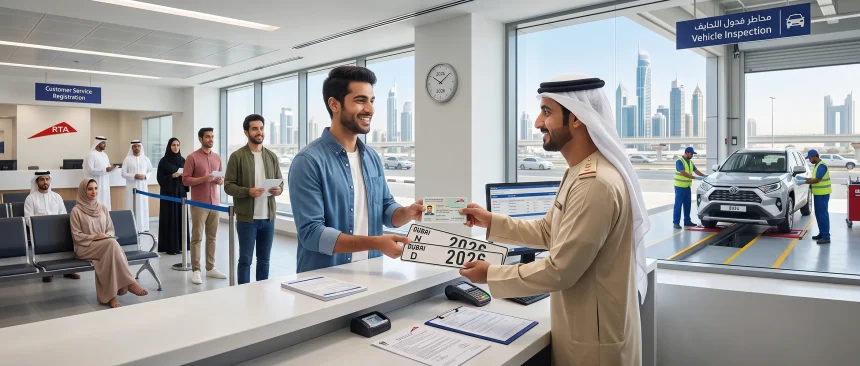
This is where everything ties up. Fore obrand-new new vehicle, the dealership does this for you by opening the traffic file, insuring your car, and getting your Mulkiya and license plawithinjust a few days after purchase.
For a used car, both buyer and seller need to be present:
- Clear all outstanding traffic fines and Salik charges on the vehicle.
- Book a technical inspection if the car is older than three years (Tasjeel or Shamil centers).
- Visit an RTA service center together, or complete the transfer digitally where eligible.
- Sign the ownership transfer form and pay the transfer fee.
- Choose to keep the existing number plate or select a new one.
- Collect your new Mulkiya in your name.
You have 14 days from the sale date to complete this. Miss it, and fines start stacking up.
What It Actually Costs?
Numbers help more than vague reassurances, so here’s a realistic breakdown for a standard private vehicle in 2026.
| Item | Approximate cost (AED) |
| New car registration fee | 400 |
| Used car transfer fee | 350 |
| Knowledge & Innovation fee | 20 |
| Technical inspection (cars 3+ years) | 170 |
| Driving license eye test | 160 |
| License exchange/file fee | 950 |
| Third-party insurance (annual) | From 630 |
| Comprehensive insurance (annual) | From 1,350 |
Add these up and a used car purchase can involve close to AED 1,500–2,000 in fees alone, on top of the car’s price.
Importing a Car From Abroad
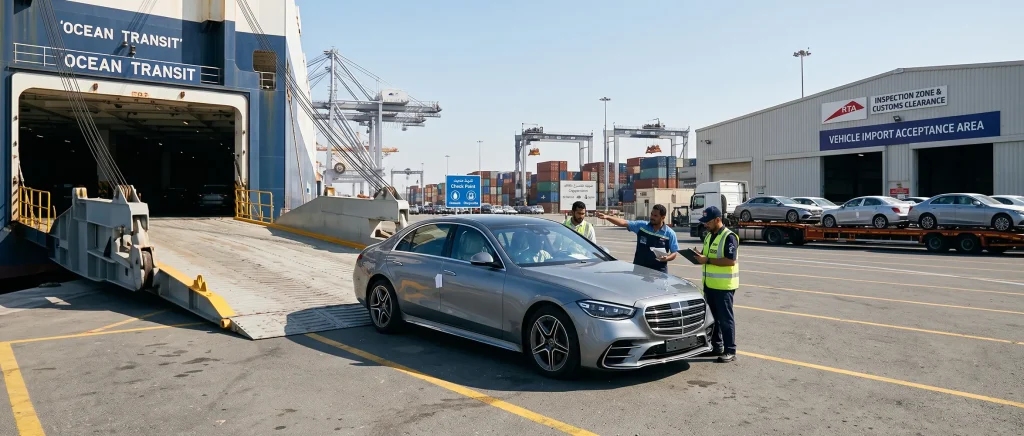
Others may import a vehicle for reasons such as sentimental attachment, an exotic model, or simply because that’s how they prefer to travel. This is feasible, but you must meet certain strict conditions. The vehicle must be no more than four years old (except for classic and luxury cars), meet GCC standards, have an odometer showing kilometers, and have Arabic markings for safety. Duties and charges, including mandatory RTA inspection, will apply on arrival.
Common Mistakes New Expats Make
A few patterns show up again and again in expat forums and RTA complaint data:
- Buying before residency and Emirates ID are finalized, then scrambling to register later.
- Skipping the pre-purchase inspection on a used car and discovering hidden accident history afterward.
- Choosing third-party insurance on a financed car, which most banks won’t even allow.
- Forgetting that unpaid Salik tolls and fines from the previous owner block registration transfer.
- Not checking parking permit requirements in their new building or community before committing to a car.
Avoiding these isn’t complicated. It just takes reading the fine print once, properly.
Staying on Top of Car News in the UAE
The rules change more often than you might think. The license agreement process changes throughout the year; registration fees change; and RTA online services evolve. Sticking to trusted sources of automotive news, such as the RTA website, Dubai Media Office, and well-known automotive websites in the UAE, will prevent you from acting on the outdated advice your friend gave you six months ago. What was relevant six months ago may no longer be true.
Getting There, One Step at a Time
Getting your first car in your new area doesn’t have to be a hassle if you understand the process: residency, driving license, insurance, and finally vehicle registration. Miss one step, and you can’t move forward. Plan the entire process accordingly, and choose a car based on how long you plan to stay. Roads in Dubai are for those who come prepared.
FAQs
1. Can I buy a car in Dubai before my Emirates ID is issued?
A. Technically, you can browse and even reserve one, but you can’t register or insure it until your Emirates ID and residence visa are active. Most dealerships won’t finalize the sale without them.
2. Do I need a UAE driving license to buy a car, or just to drive it?
A. You can technically own a car without a UAE license, but you can’t legally drive it, and insurers typically require a valid UAE license on the policy anyway.
3. Is comprehensive insurance mandatory for expats?
A. No, third-party is the legal minimum for everyone. But if your car is financed, your bank will almost certainly require comprehensive cover as a loan condition.
4. How long does car registration take for a new expat?
A. For a new car bought from a dealership, often just a few days. For a used car with a private seller, it can be same-day if all fines are cleared and inspection passes.
5. What happens if I miss the 14-day transfer deadline on a used car?
A. Fines apply immediately. Daily penalties plus the risk of the vehicle being impounded until registration is completed in the buyer’s name.