
What if the car you’ve been eyeing for months is sitting in a showroom right now, and the only thing standing between you and the keys is picking the right bank? Most people spend weeks comparing car models but barely ten minutes comparing loans, and that’s where they lose real money.
Interest rates, processing fees, and down payments in the UAE can vary by a full percent from one bank to another. Here is your guide that gives a detailed summary of what every financial institution is offering for 2026.
Why Bank-By-Bank Comparison Actually Matters?
While one percent may not seem like much, it can add up over a five-year loan. Over time, it could cost you hundreds of dirhams more for the same amount. In addition, banks have their own criteria for application processing fees, minimum salary requirements, and maximum car age, among other considerations. For this reason, financial service providers insist you compare options first. If you are looking for the cheapest car loan interest rate in the UAE, you should compare at least three or four banks.
Car Loan Interest Rates In The UAE Banks: 2026 Snapshot
Here is a comparative analysis of advertisements of various banks operating in the UAE in 2018. This is the basic interest rate offered by the banks to salaried individuals having good credit ratings. Your final offer will depend on your salary and employer type.
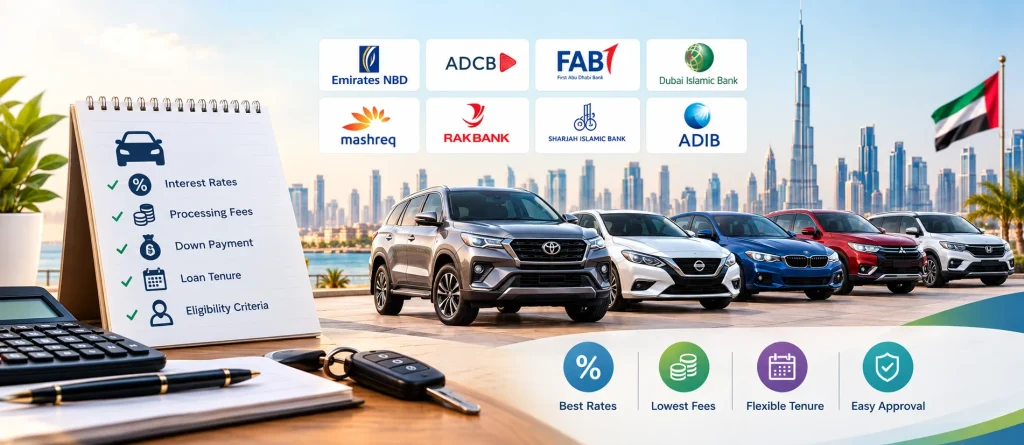
| Bank | Starting Flat Rate (p.a.) | Max Tenure | Max Finance | Min Salary (Expats) |
| Emirates NBD | From 2.49%–2.99% | 60 months | Up to 80% | AED 8,000 |
| ADCB | From 2.69%–2.75% | 60 months | Up to 80% | AED 8,000 |
| FAB | From 2.59% | 60 months | Up to 80% | AED 7,000 |
| Dubai Islamic Bank | From 2.75%–2.99% (Murabaha profit rate) | 48–60 months | Up to 80% | AED 8,000 |
| Mashreq Bank | From 2.69%–2.89% | 48 months | Up to 80% | AED 7,000 |
| RAKBANK | From 3.09% | 60 months | Up to 80% | AED 8,000 |
| Sharjah Islamic Bank | From 1.69%–1.99% | 60 months | Up to 80% | AED 5,000 |
| Abu Dhabi Islamic Bank (ADIB) | From 2.5%–2.9% | 60 months | Up to 80% | AED 5,000–7,000 |
Rates change frequently based on Central Bank policy and internal bank targets, so treat this table as a starting reference, not a locked-in quote.
Flat Rate vs Reducing Rate: The Detail Most People Miss
Banks prefer the flat interest rate method simply because the figure appears lower on paper. However, the flat interest rate applies to the total sum borrowed from the start of the tenure and not the remaining balance. The reducing interest rate, also called the annual percentage rate, depends on the outstanding balance. For example, a flat interest rate of 2.49% equals about 4.5% to 5% on a reducing-interest basis. It is important to get the reducing interest rate figures from the bank.
Islamic Car Finance vs Conventional Loans
Islamic banks such as Dubai Islamic Bank and ADIB do not literally collect “interest.” Instead, they use Murabaha. That is, the bank purchases the car and then sells it back to the customer at a set profit margin, paid in installments. It complies with Shariah principles and is available to any resident, regardless of religion. The overall price is similar to that of a standard loan. The only difference is the structure and terminology, not the total amount you end up paying. When choosing the most beneficial car financing offers in the UAE, you should get quotes from both types of banks, as rates change each month.
What Banks Actually Look At?
The approval process isn’t limited to the salary slip you provide. Lenders also consider other factors when deciding on interest rates and loan amounts.
- Monthly salary: typically AED 5,000 to AED 8,000 minimum, varying by bank and nationality
- Employer category: government and listed “Category A” companies usually unlock better rates
- AECB credit score: a score above 580 generally qualifies for mainstream rates
- Salary transfer: transferring your salary to the lending bank often shaves 0.5%–1% off the flat rate
- Car age: most banks cap financing at cars under 10-11 years old at loan maturity
- Down payment: 15-20% for new cars, 20-25% or more for used ones
New Car vs Used Car Loans
New car loans tend to have lower interest rates as the car is worth more as collateral. Interest rates for used car loans tend to be about 0.3% to 1% higher than new car loans because they carry more risk for the lender. This is also because the loan-to-value ratio decreases for used cars, requiring a larger down payment.
Documents You’ll Typically Need
- Valid Emirates ID and passport copy
- UAE residence visa
- Salary certificate or last 3 months’ bank statements
- Trade license and financials (for self-employed applicants)
- Dealer quotation or vehicle valuation certificate (for used cars)
With complete paperwork, pre-approval usually comes through in 24-48 hours, and full disbursement can take another 2-5 working days once everything is verified.
Using a Car Loan Calculator UAE Tool Before You Apply
Run the numbers for yourself before visiting the branch. Using the car loan calculator UAE, you can enter the car price, down payment, tenure, and interest rate to find your EMIs and total repayment cost. This matters because some low-interest rates with long tenures may cost more than higher interest rates with shorter tenures. You can run a few scenarios on the car loan calculator UAE and then negotiate.
Tips To Actually Get The Lowest Rate
Getting a better-than-advertised rate isn’t luck. It comes down to preparation and timing:
- Transfer your salary to the lending bank if possible
- Maintain a clean AECB credit report with no missed payments
- Apply during promotional periods, which banks often run around Dubai Motor Show season or year-end
- Negotiate the processing fee separately from the interest rate
- Get at least three quotes before committing, since rates on similar profiles can differ by a full percent
Keeping an Eye on Auto News Today
Auto financing doesn’t exist in isolation. It is an integral part of the bigger economic cycle. You can stay informed about fluctuating interest rates by watching changes in monetary policy, bank-season specials, and the connection between dealers and banks when they offer better rates than banks on their own.
Early Settlement and Hidden Costs
If you believe you will be able to settle the loan ahead of time, be sure to know about the early settlement charges beforehand. While some banks charge 1% of the remaining balance as an early settlement charge, others exempt selected loan products. Also consider the processing charge of AED 500 to 1,500 or 1% of the total loan amount, along with comprehensive insurance.
Conclusion
An automobile financing facility in the UAE is more than finding a lower interest rate. Instead, it’s about reading the fine print that comes with the loan. Flat or reducing interest rates, salary transfer schemes, and fees are all elements that contribute to the interest rate that is charged. Compare at least three banking institutions before making any calculations.
FAQ
1. What is the lowest car loan interest rate in the UAE right now?
A. Islamic banks offer flat rates as low as 1.69% to 1.99% to qualified customers. However, the rates that conventional banks charge start from 2.49% to 3.25% depending on salary and employer type.
2. Can expats get car loans in the UAE?
A. Yes, the majority of banks do offer loans to expats who have a valid visa and Emirates ID. The minimum salary required is higher for expats compared to UAE citizens, mostly AED 7,000-8,000.
3. Is a flat rate or a reducing rate better for comparison?
A. When your rate is reducing, you get your actual interest rate because it’s based on the remaining balance and not the initial balance. When you come across an offer of a flat interest rate, convert it into the reducing rate.
4. Do Islamic car loans cost more than conventional ones?
A. Not necessarily. Islamic Murabaha financing is structured differently but is generally competitive with conventional interest rates once you compare the total repayment amount.
5. How much down payment is required for a car loan in UAE?
A. New cars typically need a 15–20% down payment, while used cars require 20–25% or more, depending on the vehicle’s age and the bank’s policy.