Thinking about going electric in the UAE but worried about where and how to charge? You are not alone. The country now has thousands of public chargers, and the numbers keep growing.
But free charging has ended in most places, prices vary by network, and home installation needs approval. This guide explains everything in plain words: what you will pay, which networks to use, how Tesla fits in, and how to set up a charger at home.
Every figure comes from recent 2026 reports, so you can plan your next EV move with confidence. Let’s get started.
Why EV Charging Is a Big Deal in the UAE?
More drivers are switching to electric cars every year. Lower running costs, new Chinese brands, and strong government support are the main reasons. With Special 95 petrol at about AED 2.48 per liter in March 2026, an EV looks like a smart money move. Charging is also getting easier. The catch is that prices, apps, and rules change from one emirate to another. This guide keeps things simple, so you know what to expect before you plug in.
EV Charging in UAE: Understanding Charger Types
Before looking at networks, it helps to know the basic charger types. They decide how fast you charge and how much you pay.
| Type | Power | Best For | Typical Use |
| Home wallbox (AC) | 7–22 kW | Overnight charging | Villas, parking spots |
| Public AC | 7–22 kW | Malls, offices | A few hours of parking |
| Public DC fast | 50–350 kW | Road trips | Quick top-ups |
Your car also limits the speed. A charger that gives more power than your car can accept will not charge any faster. Check your car’s maximum AC and DC rate so you don’t pay for fast charging you cannot use.
Main EV Charging Stations UAE Networks in 2026
There is no single national network. Instead, several utilities and companies run EV charging stations that UAE drivers can use. Here are the main ones.
| Network | Where | Charger Type | Typical Tariff (before VAT) |
| DEWA Green Charger | Dubai | AC 7–22 kW, DC 50 kW+ | AED 0.70 AC / AED 1.20 DC |
| Charge AD | Abu Dhabi, Al Ain, Al Dhafra | AC and DC | AED 0.70 AC / AED 1.20 DC |
| ADNOC Distribution | Highways and fuel stations | DC up to 350 kW | Around AED 1.20 |
| UAEV | Intercity highways | Fast DC | Same standard rates |
| Tesla Supercharger | Major cities and highways | Up to 250 kW | Around AED 1.20 (check app) |
A few things worth knowing:
- Abu Dhabi launched Charge AD in 2025 with about 1,000 charging stations across roughly 400 locations.
- UAEV is targeting 1,000 chargers by 2030, focusing on highways and intercity routes.
- ADNOC stations are handy for long drives between emirates.
Each network has its own app. Most chargers use the Type 2 or CCS2 plug, so check your car’s port before heading out.
How Much Does EV Charging Cost in the UAE?
Free public charging is over in most places. DEWA now charges AED 0.735 per kWh for AC and AED 1.26 per kWh for DC, including VAT. That’s the AED 0.70 and AED 1.20 base rates plus 5% VAT. Here is what a full charge costs, based on reported figures:
| Battery Size | Public AC (0–100%) | Public DC (0–100%) | Home (AED 0.23–0.38/kWh) |
| 60 kWh | About AED 44 | About AED 76 | About AED 14–23 |
| 75 kWh | About AED 55 | About AED 95 | About AED 17–29 |
Now compare it with petrol. These numbers are illustrative. They assume an EV that uses 17 kWh per 100 km and a petrol car that does 15 km per liter at AED 2.48.
| Fuel Source | Cost per 100 km |
| Home charging | AED 4–7 |
| Public AC | About AED 12.50 |
| Petrol car | About AED 16.50 |
| Public DC fast charging | About AED 21.50 |
The surprise here is that regular DC fast charging can cost more than petrol. Use it for road trips, not daily top-ups. Home charging is where the real savings are.
DEWA EV Green Charger: Dubai’s Main Network
The DEWA EV Green Charger is the backbone of Dubai charging. It was the first public EV network in the region, and it keeps growing. Dubai had about 1,860 charging points in January 2026, with a target of 10,000 by December 2026. That target is ambitious, so watch for updates through the year.
How to use it:
- Register in the DEWA Smart App or get an EV Green Charger card.
- Find a nearby charger and check its tariff and availability.
- Plug in, start the session in the app, and pay per kWh.
- Visitors can use a QR code for guest sessions.
Stations at Dubai Mall and Mall of the Emirates tend to be open around the clock. Chargers are also found in residential communities like JVC, Business Bay and Al Barsha, as well as government buildings and transit routes. Some guides mention free charging for new registered users during the first year. Others say free charging has fully ended. Rules can change, so confirm in the DEWA app before you count on any free offer.
Tesla Charging UAE: What Owners Should Know?
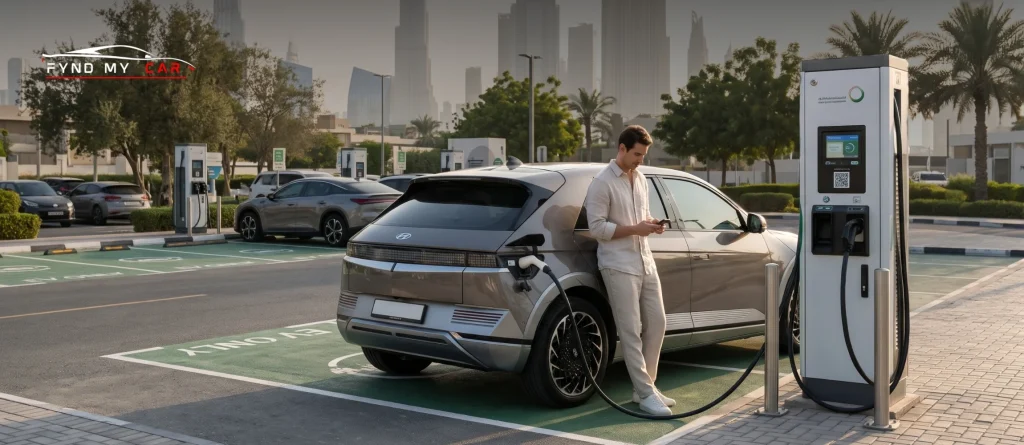
Tesla charging in the UAE is simple because Tesla runs its own Supercharger network with automatic billing through the Tesla app. You plug in, and the car does the rest.
Key locations include:
- Dubai Mall and Mall of the Emirates
- Jebel Ali (Last Exit, Sheik Zayed Road), with 8 Superchargers delivering up to 250 kW
- Yas Mall, Masdar City, and Al Mirfa in Abu Dhabi
- Sharjah City Center and Rahmania Mall
- City Center Ajman, with 8 Superchargers and up to 250 kW
On pricing, Tesla charged around AED 1.2 per kWh at Mall of the Emirates in 2025. Idle fees of AED 2 or AED 4 per minute applied, depending on how busy the site was. Move your car once you reach your charge limit. There is a recent twist. In 2026, Tesla activated free Supercharging at more than 30 stations across the UAE, Saudi Arabia, and Qatar. It was reported as temporary support during a difficult period, and no end date was announced. Check the Tesla app for live pricing before assuming it is still free.
Home EV Charger Dubai: Your Complete Setup Guide
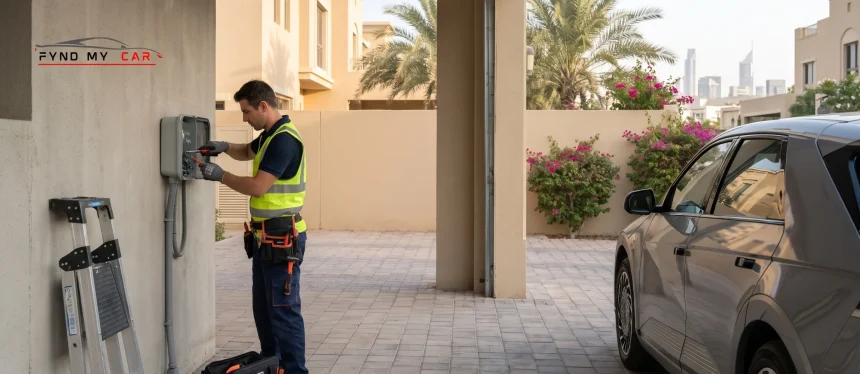
Charging at home is cheaper and more convenient. A home EV charger Dubai setup needs a few steps, but it is not complicated.
Step-by-Step Process
- Check your home type (villa or apartment) and your power supply.
- Pick a Type 2 wallbox that suits your car’s AC limit.
- Hire a DEWA-approved electrical contractor.
- Submit documents and plans for approval. This typically takes 5 to 7 working days in Dubai.
- Get the charger installed, tested, and activated.
Apartment owners need extra steps. You will usually need a no-objection certificate (NOC) from your building management, along with the utility approval. Start that conversation early.
Home Charger Costs
| Item | Estimated Cost (AED) |
| Wallbox (7–11 kW) | 1,200–2,500 |
| Electrical installation | 500–1,000 |
| DEWA approval fees | 200–500 |
| Typical total | 2,000–4,000 |
Some setups cost more. A fully installed 7.4 kW unit is often quoted at AED 3,000 to 4,000, and higher-end systems can reach AED 6,000. Some car brands include free or discounted wallbox installation with a new car, so always ask your dealer. Packaged installation services are also available, often completed within a couple of days.
Speed and Safety
A 7 kW wallbox charges a mid-size electric SUV in about 9 hours, which suits overnight charging. Choose a charger with at least an IP65 rating, so it can handle UAE heat, dust, and sand.
Home Electricity Rates
Home charging in Dubai costs about AED 0.23 to AED 0.38 per kWh, because DEWA’s residential tariff is slab-based. Charging a car can push part of your usage into a higher slab. Even then, home charging stays far cheaper than public DC.
Smart Tips to Save Money and Time
- Charge at home when you can: It is the cheapest option by a wide margin.
- Use AC for daily needs: Save DC fast charging for road trips.
- Charge between 20% and 80%: Charging slows down near full, so the last 20% wastes time.
- Plan trips around chargers: Aim to charge at 30–40%, not 10%.
- Watch for idle fees: Move your car as soon as charging ends.
- Check live availability: Popular malls fill up fast in peak hours.
- Carry a backup plan: Know two chargers near your route, in case one is busy or offline.
Stay Updated With Recent Auto News
Rules and prices in this space move quickly. Following recent auto news helps you spot tariff changes, new network launches, and fresh incentives before they affect your wallet. Watch especially for DEWA’s progress toward its 10,000-charger target, any change to Tesla’s free Supercharging, and new highway chargers from UAEV and ADNOC. Also remember that guides sometimes quote slightly different numbers. The tariff shown in your charging app on the day is the one that counts.
Conclusion
EV charging in the UAE is easier than ever, but smart planning still pays off. Charge at home for daily needs, use public AC chargers when you are out, and keep fast chargers for long road trips. Always check your charging app for live prices, because tariffs and offers can change quickly. Before installing a home charger, confirm approval rules with your utility and building management. With a little preparation, going electric becomes simple, affordable, and stress-free. Start small, track your costs for a month, and enjoy cheaper, cleaner driving.
FAQs
1. Is EV charging free in the UAE?
A. Mostly no. Free public charging has ended in Dubai. Some temporary offers exist, such as Tesla’s recent free Supercharging at selected sites. Always check the app first.
2. How much does DEWA charge per kWh?
A. The base rates are AED 0.70 for AC and AED 1.20 for DC. With 5% VAT, that becomes AED 0.735 and AED 1.26.
3. Do I need approval to install a home charger in Dubai?
A. Yes. You need DEWA approval and a DEWA-approved contractor. Apartment residents also need building management permission.
4. How much does a home charger cost?
A. Most setups cost about AED 2,000 to AED 4,000 in total, including the wallbox, installation, and approval fees. Premium setups can cost more.
5. Can I use Tesla Superchargers if I don’t own a Tesla?
A. Access for other brands depends on the site and Tesla’s current rules. Check the Tesla app before you go, and keep DEWA, Charge AD, or ADNOC chargers as a backup.