
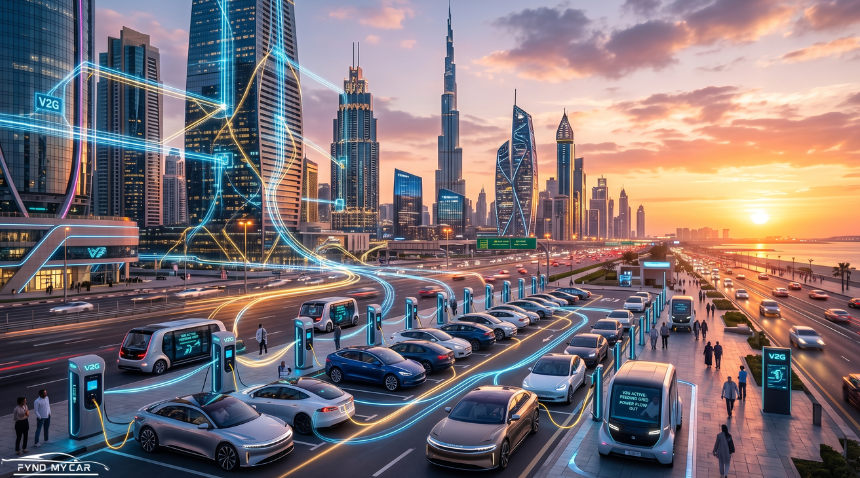
The electric vehicle scene in the UAE is shifting gears; your car is turning into more than just a ride; it’s becoming a functional part of the power grid. Vehicle-to-Grid in the UAE is the hot topic here, promising a world where your EV doesn’t just sit in the driveway but actively stores, shares, and even trades energy. While the rest of the world is experimenting, the UAE is currently laying the groundwork with pilot tests and serious infrastructure planning.
Understanding V2G: More Than Just Charging
Think of V2G as flipping the script on how we use power. Normally, your car is a vacuum, sucking up electricity. With V2G, it becomes a mobile battery. It can soak up energy when it’s cheap and plentiful, then feed it back when the grid needs a hand.
During peak UAE summer months, V2G architectures can theoretically allow EVs to offset residential cooling loads by discharging up to ~3.6 kW. However, in the UAE, any bidirectional energy flow into a home or the grid must be routed through a DEWA-approved bidirectional smart meter under the Shams Dubai initiative. Unauthorized direct discharge into the residential grid without this configuration is not permitted due to safety and grid synchronization protocols.
It’s not just about convenience; it’s about stability. By letting EVs talk back to the grid, we could smooth out those spikes in energy demand. Globally, the tech is already proving its worth, turning cars into backup power sources during blackouts, and it’s only a matter of time before that hits home here.
The Current Status of V2G in the UAE
As of early 2026, Vehicle-to-Grid in the UAE is still firmly in the “pilot” stage. Big players like DEWA are running the numbers and testing how this works on the ground, but you can’t exactly go out and buy a fully functional V2G-to-grid setup for your home just yet.
We’re hitting a few speed bumps:
- We need way more bidirectional chargers on the market.
- The legal side, figuring out how to actually sell that power back, is still being drafted.
- Grid integration must align with DEWA’s standard residential supply parameters of 230V / 50Hz, requiring V2G systems and chargers to be fully compatible with these specifications for safe and synchronized energy exchange.
- Our grid and smart meters need to be fully synced up for this two-way conversation.
That said, the trajectory is clear. The UAE is betting big on smart cities and clean energy, so don’t be surprised to see this move from “experimental” to “everyday life” before we hit 2030.
Why EV Home Charging is Evolving
The growth of EV Home Charging in the UAE is the secret sauce behind the V2G movement. Usually, charging is a one-way street, from the grid to the car. But with the new bidirectional setups, that flow can reverse, letting your house “borrow” power from your car during a heatwave or a power dip.
This brings some serious perks:
- Lower electricity bills by avoiding peak-rate pricing.
- A built-in backup generator for when the lights go out.
- Smoother integration if you already have solar panels on your roof.
Pretty soon, EV Home Charging in the UAE won’t just be about waking up to a full battery; it’ll be about optimizing your entire home’s energy footprint.
Grid-Ready EVs in 2026: Who’s Leading?
Not every EV out there is built for this. If you want to be part of the future, you need a car that speaks the language of the grid. Let’s look at two big names that are already pushing the envelope.
Kia EV9: The Flagship of Bidirectional Innovation
The Kia EV9 utilizes a 99.8 kWh battery pack to support V2L operations, outputting a sustained 3.68 kW to offset peak household loads. It’s built for V2L (Vehicle-to-Load) and V2H (Vehicle-to-Home), and it’s primed for full V2G integration.
- Works seamlessly with advanced bidirectional chargers like the Wallbox Quasar 2.
- Equipped with a 99.8 kWh battery pack and a V2L output capacity of up to 3.68 kW, enabling it to power essential household loads during outages or peak demand periods.
- It uses current CCS standards, making it ready for future grid connections.
Global trials show the EV9 is already feeding energy back into homes, showing it’s basically ready for the UAE the moment the regulations catch up.
Nissan Leaf: The Original V2G Pioneer
You can’t talk about this tech without mentioning the Leaf. It’s been the grandfather of V2G for years. It uses the CHAdeMO standard, which has allowed it to play nice with bidirectional charging long before the rest of the industry joined in.
- It’s a battle-tested pro in real-world grid services.
- Used in countless global pilots to prove that demand response works.
The catch? The industry is leaning toward CCS, and the Leaf’s CHAdeMO standard might be the only thing holding it back from being the long-term king in the UAE.
The Roadblocks to Mass Adoption
Even with the cool tech, Vehicle-to-Grid in the UAE has a few hurdles to clear before it’s everywhere:
- The Infrastructure Gap: Bidirectional chargers are still rare and carry a heavy price tag.
- The Red Tape: We’re still waiting for official policies on how residents can sell power back to the grid.
- The Learning Curve: Most drivers haven’t even realized their car could be an energy asset yet.
- Grid Tech: Utilities need to roll out smarter systems to manage thousands of cars all hitting the grid at once.
Luckily, global standards like ISO 15118 are already being built to make sure your car and the grid understand each other perfectly.
What the Future Looks Like
The UAE has all the ingredients to lead the region here. Between the push for renewables and the obsession with smart tech, the foundation is solid. By 2030, don’t be shocked if your car is just another node in a decentralized power network.
We’re looking at a world of dynamic pricing, solar-powered home integration, and EVs that essentially pay for themselves by acting as miniature power plants.
Conclusion
The future of Vehicle-to-Grid in the UAE is bright, but it’s still getting its legs. We’re in that “wait-and-see” phase of 2026, where the tech is here, but the laws are still being written.
At the same time, the improvements in EV Home Charging in the UAE are setting the stage for this massive shift. Soon enough, our homes, our cars, and our power grid will all be one interconnected web. For those buying an EV in 2026, picking a grid-ready model like the Kia EV9 or the Nissan Leaf isn’t just about avoiding the pump; it’s about making a bet on a smarter, more resilient way to power your life.
FAQs
1. What is Vehicle-to-Grid (V2G) technology in EVs?
V2G allows electric vehicles to send stored electricity back to the grid, supporting energy balance and efficiency.
2. Is Vehicle-to-Grid in the UAE available for public use?
Currently, Vehicle-to-Grid in the UAE is in pilot phase and not yet commercially available for everyday users.
3. Which EVs support bidirectional charging in 2026?
Models like Kia EV9 and Nissan Leaf support bidirectional charging, making them suitable for future V2G integration.
4. How does EV home charging change with V2G technology?
EV Home Charging in the UAE evolves with V2G by enabling energy flow from car to home during peak hours.
5. What are the main challenges for V2G adoption in the UAE?
Key challenges include infrastructure costs, limited chargers, evolving regulations, and a lack of consumer awareness about V2G benefits.