
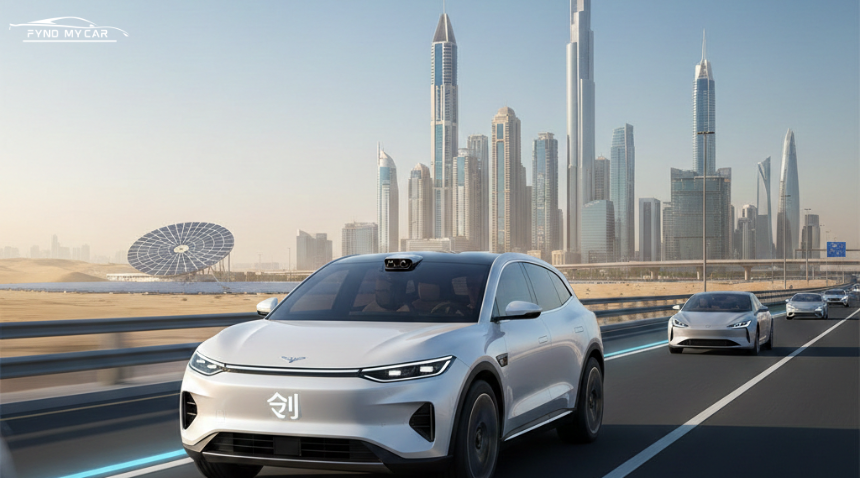
The landscape of the United Arab Emirates automotive market has undergone a seismic shift over the last half-decade.
Fast forward to 2026, and the visual data tells a different story. The sharp LEDs, massive panoramic sunroofs, and aggressive grille designs of Chinese SUVs have become a staple on UAE roads.
Dive into this comprehensive guide to explore the mechanics of the industry, the reality of the supply chain, and the evolving standards of automotive engineering. Also, know about the 2026 reality of Chinese automotive ownership in the Middle East.
Quality Over Quantity in The 2026 Paradigm
By 2026, the Chinese automotive industry has moved past its imitation phase. We are now firmly in the era of innovation. Major Chinese conglomerates have established dedicated R&D centers within the GCC to stress-test vehicles against the brutal humidity of the Northern Emirates and the scorching heat of the Empty Quarter.
Structural Integrity and Crash Ratings
Safety is no longer a footnote for Chinese manufacturers. In 2026, the gap between C-NCAP (China New Car Assessment Program) and Euro NCAP has narrowed significantly. Most flagship SUVs arriving in Dubai and Abu Dhabi showrooms now carry five-star ratings.
These vehicles are built using high-strength steel cages and, in many cases, incorporate chassis technology born from partnerships with established European brands.
When discussing Chinese SUV safety UAE 2026, one must highlight the standard inclusion of Advanced Driver Assistance Systems (ADAS). In the high-speed, multi-lane environment of the UAE, these vehicles features like AEB and Lane keep assist are standard safety expectations.
The Value Proposition: Why the UAE is Hooked?
Chinese manufacturers have filled this void by offering Executive Suite luxury at Compact Sedan prices.
For the price of a base-model hatchback from a legacy brand, a buyer in the UAE can now secure a full-sized, seven-seater Chinese SUV equipped with Nappa leather, dual 12-inch screens, and ventilated seats, a must-have for the 50-degree Celsius summers. This disruption is the biggest trending car news of the decade.
The Aftersales Struggle
While the safety of the vehicle in a crash is high, your investment is safe. The rapid expansion of Chinese brands has occasionally outpaced their local infrastructure.
The Parts Waiting Time Dilemma
If you are buying Chinese SUV in UAE, you must account for the logistics of spare parts. While routine service items (oil filters, brake pads) are readily available, specialized body panels or complex electronic modules can sometimes face a waiting list reality.
Chinese manufacturers release new models at a pace twice as fast as Japanese brands, and local dealerships often struggle to maintain a 100% stock rate for every specific trim.
If you are involved in a fender bender, your vehicle might sit in a workshop for 3 to 6 weeks while a specific sensor or bumper bracket is shipped from Shenzhen. This is the tax owners pay for the initial low purchase price.
Automotive Industry Trends For Software-Defined Vehicles
A major trend in 2026 is the transition to Software-Defined Vehicles (SDVs). Chinese SUVs are essentially smartphones on wheels. This brings a different kind of safety, i.e, Cybersecurity.
As these cars are permanently connected to 5G networks for navigation and Over-the-Air (OTA) updates, manufacturers have invested heavily in data encryption to ensure the vehicle’s systems are protected from external interference.
Furthermore, the car tuning news sector is seeing a shift. Traditionally, tuning in the UAE involved mechanical upgrades to turbos and exhausts.
In 2026, tuning a Chinese SUV often involves software remapping to optimize the AC compressor performance for the Gulf climate or unlocking hidden infotainment features. The community of enthusiasts modifying these vehicles is growing, signaling a high level of trust in the base mechanical components.
The GCC Spec Performance in the Heat
Safety in the UAE also means Thermal Safety. A car that overheats on the E11 during rush hour is a safety hazard. By 2026, GCC Spec for Chinese brands will have become more than just a sticker. It involves:
- Over-engineered Cooling Systems: Larger radiators and more powerful electric fans to handle idling in traffic.
- UV Protection: Specialized glass coatings to prevent the interior plastics from off-gassing or cracking under the intense Arabian sun.
- Advanced AC Compressors: Specifically sourced to ensure that even at a standstill, the cabin remains at a crisp 18 degrees.
The Resale Value of Chinese SUVs
In 2026, the resale value of Chinese SUVs in the UAE has stabilized. While they still depreciate faster than a Toyota Land Cruiser, the gap is closing. As more people see these cars lasting 5+ years without major mechanical failures, the second-hand market is becoming more robust.
Buyers are realizing that even if the resale is lower, the initial saving of AED 50,000 to AED 80,000 compared to a legacy brand more than compensates for the depreciation hit.
Conclusion
Mechanically and structurally, Chinese SUVs in 2026 are on par with global standards. They offer world-class safety tech that keeps families protected on the UAE’s high-speed roads.
You are trading the instant parts availability of a legacy brand for a futuristic, luxury-laden experience at a fraction of the cost. For the savvy resident who maintains their vehicle at authorized centers and drives defensively, a Chinese SUV is the most logical automotive choice in the current UAE economy.
FAQs
1. Do Chinese SUVs in the UAE come with a 2026-standard warranty?
Yes, most major Chinese brands in the UAE now offer aggressive warranty packages, often spanning 5 to 7 years or up to 150,000 km. Some even offer lifetime powertrain warranties to build consumer trust, which is a major trend in the 2026 market.
2. How do Chinese SUVs handle the extreme UAE sand and dust?
Current models utilize high-grade filtration systems (often N95 certified) to keep dust out of the cabin and the engine. The air intake systems are designed to minimize sand ingestion, making them as durable as their international counterparts for city and light off-road use.
3. Is it hard to find a workshop that can repair a Chinese SUV?
While third-party garages are catching up, it is highly recommended to use official agency workshops in 2026. The high level of electronic integration and proprietary software in these vehicles means that specialized diagnostic tools are required for most repairs.
4. Are the safety features like ‘Auto-Pilot’ reliable on UAE roads?
The Level 2 and Level 2+ autonomous features in 2026 Chinese SUVs are specifically calibrated for the UAE’s well-marked roads. However, like any brand, these are assistance features, and drivers must remain attentive, especially during unpredictable weather like heavy fog or sandstorms.
5. Why are parts waiting times longer for some Chinese brands?
The primary reason is the sheer variety of models. Chinese manufacturers iterate very quickly. While this gives you the latest tech, it means parts distribution centers must manage a massive catalog of components, which can occasionally lead to logistical bottlenecks in the supply chain.