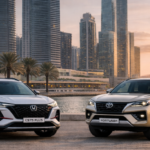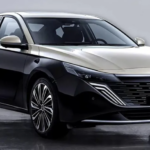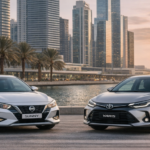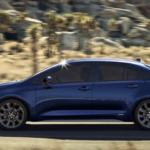

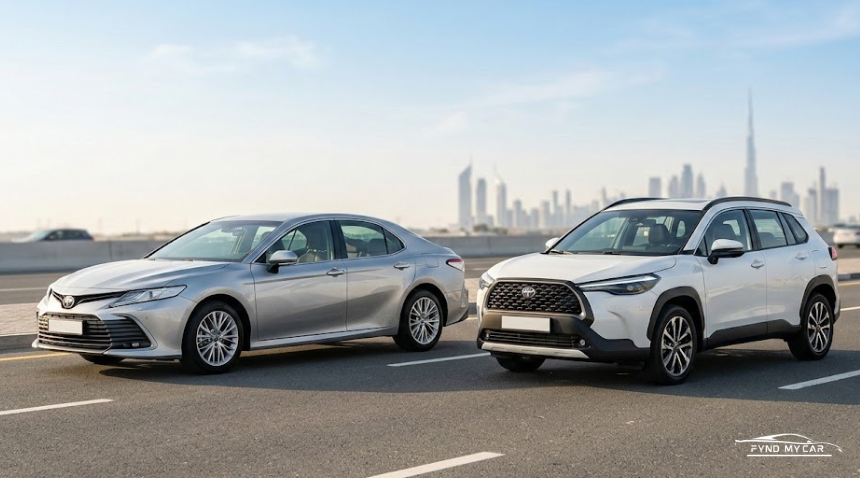
The hybrid space in the UAE is getting more practical, and that shift is clearly visible in how mainstream models are being positioned. For buyers tracking auto news closely, 2026 is shaping up to be less about flashy debuts and more about value-driven electrification. Two names that sit right in that conversation are the Toyota Camry Hybrid and the Toyota Corolla Cross Hybrid, both falling into the increasingly important price band under AED 150,000.
This comparison isn’t about badge appeal or brand hype. It’s about what the numbers, mechanical layout, and real-world usability suggest for everyday drivers in the Emirates.
Powertrain Basics: Similar Philosophy, Different Scale
Both models follow Toyota’s familiar hybrid formula. A petrol engine working with an electric motor through a CVT automatic transmission. On paper, the Camry Hybrid uses a 2.5-litre (2487 cc) four-cylinder petrol engine, while the Corolla Cross Hybrid runs a smaller 1.8-litre (1798 cc) four-cylinder unit. Both engines use an in-line cylinder configuration, a 13:1 compression ratio, a DOHC valve mechanism, and four valves per cylinder.
Where they differ is in fuel delivery. The Camry uses EFI, while the Corolla Cross relies on MPFI. For most drivers, this distinction matters less in daily driving feel and more in how the engine is tuned for efficiency and smoothness within the hybrid system.
Top speed is identical at 180 km/h, which tells you something important: these cars are not being positioned as performance hybrids. They are engineered around balanced, usable power rather than outright speed. This point is often highlighted in recent car news as hybrids shift toward efficiency-first engineering.
Transmission: Keeping Things Simple
Both vehicles come with an automatic CVT and a single-speed gearbox layout. That’s standard in many hybrids because the electric motor helps cover torque gaps, so you don’t need multiple gears to do the job.
In daily driving, this means smoother acceleration, especially in stop-and-go traffic, which is a regular part of UAE city life. Drivers used to traditional automatics might notice a different feel at first, but this setup is well established now and matches what we see across auto industry news: simpler drivetrains aimed at better efficiency and long-term reliability.
Steering and Maneuverability
Both cars use rack and pinion steering with electric power assistance. Where things get slightly interesting is the turning radius. The Camry’s minimum turning radius is 5.6 metres, while the Corolla Cross comes in at 5.4 metres. It’s a small difference on paper, but in tight parking lots or basement garages, that little edge can make the Corolla Cross feel easier to place. The Camry, being a larger sedan, gives up a bit of that agility in exchange for more cabin presence and road feel.
Suspension and Braking Layout
This is where their design intentions start to separate more clearly. The Camry Hybrid uses McPherson struts with coil springs at the front and a rear multi-link double wishbone setup. That kind of rear suspension is generally associated with better ride control and stability, particularly at higher speeds. Its braking system uses a solid disc and ventilated disc combination.
The Corolla Cross Hybrid also runs McPherson struts with coil springs up front, but the rear uses a torsion beam with coil springs. A torsion beam is simpler and space-efficient, which suits crossover packaging, but it’s usually tuned more for practicality than refined ride feel. Its brakes are ventilated and solid discs.
In everyday terms, the Camry may feel more settled on long highway drives, while the Corolla Cross focuses on space efficiency and urban practicality.
Fuel Economy and Tank Size
Efficiency is the whole point of hybrids, and both models put up strong figures. The Camry Hybrid has a 50-litre fuel tank and claims 19 km/l in both city and highway driving. The Corolla Cross Hybrid has a smaller 36-litre tank and delivers 22 km/l in the city and 19 km/l on the highway.
So, on paper, the Corolla Cross is more city-efficient, which makes sense given the smaller engine and crossover role. But the Camry’s bigger tank means longer distances between fuel stops, which matters if you’re regularly driving between emirates. Sometimes range convenience counts just as much as the raw km/l number.
Size, Body Style, and Daily Use
Body style alone shapes how these cars fit into daily life. The Camry is a sedan, usually associated with smoother highway cruising, strong rear-seat comfort, and a stable feel at speed. The Corolla Cross, being a compact SUV-style vehicle, offers a higher seating position and easier entry and exit, which many families and city drivers prefer.
In UAE terms, the Camry suits people spending long hours on highways like E11 or E311. The Corolla Cross fits drivers dealing more with dense city areas and those who want flexible cargo space in a slightly taller vehicle.
Conclusion
Hybrid technology in the UAE has clearly moved past the experimental stage. It’s now predictable, usable, and part of normal buying decisions. The Camry Hybrid leans toward highway comfort, a more advanced rear suspension setup, and a larger fuel tank for longer, uninterrupted drives. The Corolla Cross Hybrid focuses more on urban efficiency, easier maneuvering, and the practicality that comes with a compact crossover shape.
For buyers under AED 150,000, hybrids are no longer a compromise. They deliver balanced performance, strong fuel economy, and familiar driving behavior. The real choice comes down to lifestyle, long highway runs versus heavy city use, sedan comfort versus crossover flexibility.
FAQs
1. Are both the Camry Hybrid and Corolla Cross Hybrid suitable for highway driving?
Yes. Both have a 180 km/h top speed and stable CVT systems, making them suitable for regular inter-emirate travel.
2. Which model is more fuel-efficient in city driving?
The Corolla Cross Hybrid, with a listed 22 km/l city figure, is more city-efficient than the Camry Hybrid at 19 km/l.
3. Does the larger engine in the Camry Hybrid mean much higher fuel consumption?
No. Its hybrid system helps keep fuel economy close to the smaller 1.8L Corolla Cross, especially in mixed driving.
4. Is there a difference in ride comfort between the two?
Yes. The Camry’s rear multi-link setup generally supports a smoother highway ride than the Corolla Cross’s torsion beam rear suspension.
5. Which one is easier to maneuver in tight city spaces?
The Corolla Cross, with a 5.4m turning radius, is slightly easier to handle in tight parking and narrow streets than the Camry.