
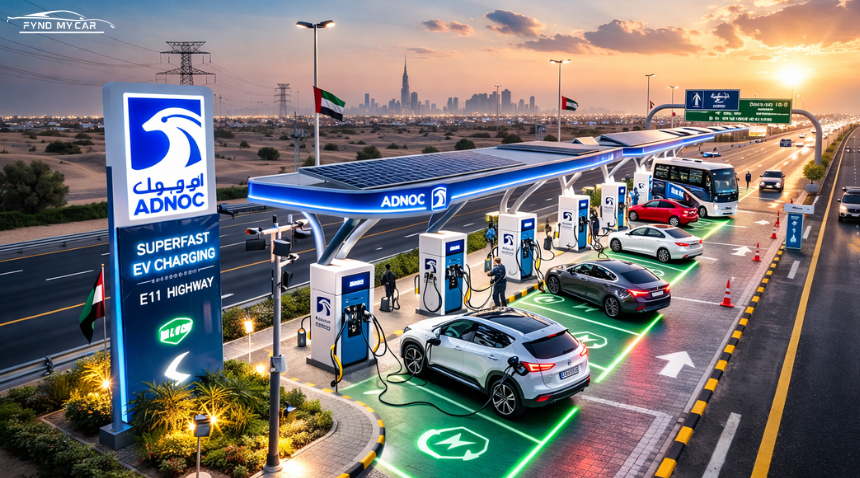
To match the changing landscape of transportation, ADNOC has recently inaugurated the superfast EV charging link on the E11 highway that commutes between Abu Dhabi and Dubai.
As the ambition is to meet carbon-neutral goals in the coming decades, the automotive industry is evolving with innovations.
In the UAE, transition is not only a theoretical goal but also a practical understanding. This is one of the milestones ADNOC has achieved, which is a commitment to the changing infrastructure.
Dive through this comprehensive blog to understand how the superfast EV charging link on the E11 highway is matching to evolving needs in the automotive industry in the UAE and what its importance is.
The Strategic Importance of the E11 Highway
To understand the magnitude of this achievement, one must first recognize the importance of the E11. As the longest road in the UAE, stretching from Al Silah in Abu Dhabi to Ras Al Khaimah, the E11 is the logistical backbone of the country. It connects major economic hubs, residential corridors, and industrial zones.
Superfast charger installation is about to bring a change and support for long-distance EV travel while enhancing the convenience of the enthusiasts.
This is a critical development in recent news in automobile industry circles, as range anxiety, the fear that an EV will run out of power before reaching a charging station, has long been cited as the primary barrier to widespread EV adoption.
Technological Specifications of Superfast Charging
The newly installed units on the E11 are designed to deliver high power outputs. Let’s understand it in more detail:
Reduced Charging Times: These chargers can replenish an EV battery from 10% to 80% in approximately 15 to 30 minutes, depending on the vehicle’s battery architecture. This aligns the charging experience with the duration of a typical highway rest stop.
CCS and CHAdeMO Compatibility: To ensure inclusivity, the link utilizes universal charging standards, making it accessible to a wide variety of EV models currently available in the market.
Grid Integration: The execution requires advanced grid management to ensure that the high power requirement of the superfast chargers does not create instabilities in the local power grid.
ADNOC’s Evolution into an Integrated Energy Provider
The completion of the E11 charging link highlights a broader trend in recent news on automobile industry dynamics, the evolution of traditional oil and gas giants into diversified energy providers. ADNOC’s investment in EV infrastructure is part of its “Low Carbon Solutions and International Growth” vertical.
By leveraging its existing network of service stations, the company is uniquely positioned to lead the transition. Motorists do not need to seek out obscure charging locations; instead, they can find high-speed charging at the same familiar locations where they previously fueled with gasoline. This integration is essential for normalizing EV ownership among the general public.
Impact on the Regional Automobile Market
The UAE has one of the highest rates of EV readiness in the region. The completion of the E11 superfast link acts as a catalyst for several market shifts:
- Increased Consumer Confidence: Prospective buyers who were hesitant about EVs due to the lack of highway charging infrastructure now have a tangible reason to make the switch.
- Support for Fleet Electrification: Logistics companies and taxi services that frequent the E11 corridor can now consider electric fleets, knowing that turnaround times for charging will not significantly impact their operational efficiency.
- Incentivizing High-Performance EVs: Many modern EVs are built with 800V architectures capable of extremely fast charging. Without chargers like those on the E11, these features would remain underutilized.
Environmental and Economic Context
The deployment of this charging link is deeply intertwined with the UAE’s net-zero by 2050 strategic initiative. Transportation is a major contributor to CO2 emissions, and decarbonizing the road network is a priority.
From an economic perspective, the shift toward a robust EV infrastructure creates a new ecosystem of jobs and services.
From the maintenance of high-tech charging hardware to the software development required for payment integration and grid management, the superfast link is more than just cables and plugs; it is an economic driver.
Challenges Overcome in the Implementation
Building a superfast charging link across a desert climate presents unique engineering challenges. High ambient temperatures can affect both the charging speed and the longevity of the charging hardware. The E11 project involved:
- Thermal Management Systems: Ensuring that the charging units remain cool during peak summer months to maintain maximum power delivery.
- User Interface Reliability: Creating durable, sunlight-readable screens and robust payment systems that can withstand harsh environmental conditions.
The Future of Charging Infrastructure in the UAE
- Solar-Powered Charging Hubs: Integrating renewable energy directly at the source to further reduce the carbon footprint of the EV ecosystem.
- Plug & Charge Technology: Implementing ISO 15118 standards where the vehicle communicates directly with the charger for automatic billing, eliminating the need for apps or RFID cards.
- Inductive Charging Experiments: While still in the early stages globally, the focus on infrastructure innovation suggests that the UAE is well-placed to test wireless charging in the future.
Conclusion
The completion of the superfast EV charging link on the E11 by ADNOC is a landmark event in recent automobile news. It bridges the gap between urban convenience and long-distance viability for electric vehicles. For the everyday driver, it means more choice, less anxiety, and a clear path toward a more sustainable future.
As the automotive sector continues to evolve, staying informed through reliable platforms is essential. While the technology under the hood of our cars is changing, the goal remains the same: efficient, safe, and accessible mobility for all. This project is a clear signal that the infrastructure of tomorrow is being built today.
FAQs
1. What is the significance of the E11 superfast charging link?
The E11 link is significant because it marks a major step in the country’s transition toward sustainable transportation and infrastructure readiness.
2. How fast are the superfast chargers installed on the E11?
Superfast chargers that are installed on the E11 highway provide high power outputs between 150 and 200 kW.
3. Can any electric vehicle use the new ADNOC charging stations?
Yes, the stations are designed to be inclusive, ensuring that the majority of modern electric vehicles available in the market can use the superfast link.
4. Why is this development considered a highlight in the region?
This development is a commitment to encourage motor enthusiasts to switch from fuel to electricity. This could turn into a revolution to adopt EVs on the road.
5. How does this project support the UAE’s environmental goals?
The project encourages the adoption of zero-emission vehicles. This directly contributes to the UAE’s Net Zero by 2050 strategy by reducing the overall carbon footprint of the transport sector.